Sunday, March 14, 2010

Out From Under: Disability, History and Things to Remember


Today, after a reluctant run with the running posse (I mean - seriously - who wants to crawl out of bed when it's all "spring ahead"? And no matter WHAT the clock says, you KNOW it's really 5:30 a.m. - not 6:30 a.m. at ALL...) In any event, we did it, even though taskmaster Tamara wasn't there today to crack le whip..... And as the sweat began to dry, I took my camera and tripod to UBC Robson Square to take in the exhibit Out From Under: Disability, History and Things to Remember once again. It just gets better each time I see it.

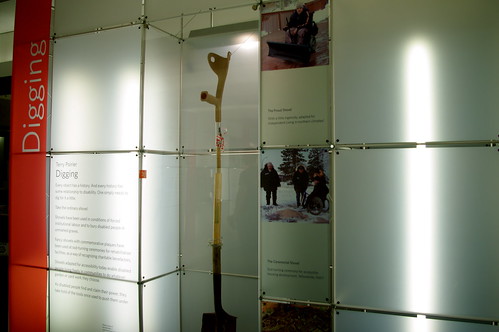
The exhibit does not attempt an academic approach to the history of disability in Canada. Rather, people were invited to respond to the call with an object that might shed light on some aspect of this complex and difficult history. The result is a completely approachable installation that urges deeper thought at each turn.

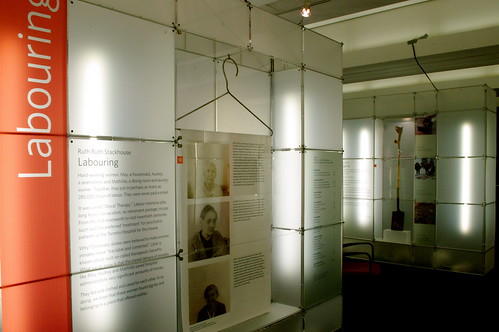
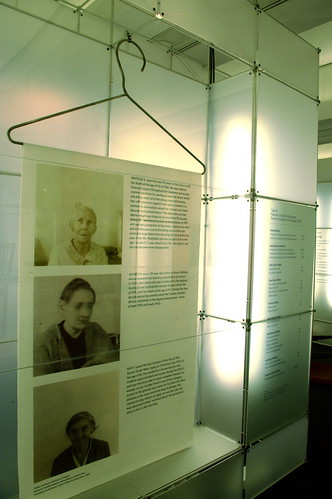
To paraphrase a press release, 13 everyday objects pay tribute to the resilience, creativity and cultural contributions to the social history of Canadians with disabilities. As a viewer, you are invited to examine these artifacts and the accompanying text that may challenge the way you've looked at subjects such as a shovel, a hanger, a pile of grey non-descript clothing. It's powerful stuff. How I wish I could take you by the hand and lead you through the exhibit which most definitely illuminates a difficult history. For those of you who don't live in Vancouver or Toronto, I'll try to give you a taste. This is from the piece called "Labouring". Here's a quote from the panel text.

"Labouring. By Ruth Ruth Stackhouse.

Hard-working women. May, a housemaid, Audrey, a seamstress and Mathilda, a dining room and laundry worker. Together, they put in perhaps as many as 285,000 hours of labour.

They were never paid a nickel.

It was called "Moral Therapy". Labour-intensive jobs, long hours, no vacation, no retirement package, no pay. From the mid-nineteenth to mid-twentieth centuries, such was the preferred ‘treatment’ for psychiatric patients at the Toronto Hospital for the Insane.

Why? Domestic duties were believed to make women inmates more "tractable and contented". Little is known about such so-called therapeutic benefits. What we do know is that the unpaid labours of inmates like May, Audrey and Mathilda saved hospital administrators very significant amounts of money.

They fed and clothed and cared for each other. In so doing, we hope that these women found dignity and belonging in a place that offered neither."

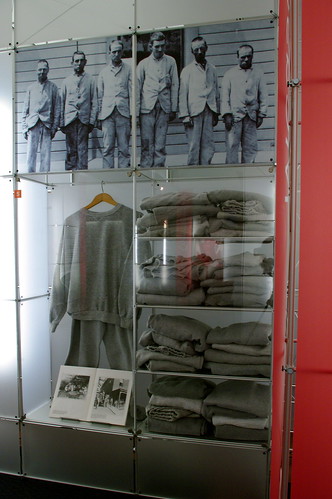
The next images and text are from "Dressing"

"By Sandra Phillips.

No pockets, no designer label and no discernible style. Track suits like this were purchased by the gross to clothe residents of institutions across the country. In institutional settings, people, like clothing, are interchangeable.

Today, despite policies of deinstitutionalization both federally and provincially, thousands of Canadians with intellectual disabilities live in conditions as drab and formless as this track suit. Nearly 500 still live in Ontario's three remaining institutions: Southwestern, Huronia and Rideau Regional Centres.

This installation honours every small claim to individuality attempted in institutional confinement – whether by gesture, deed or some expression of personal style."

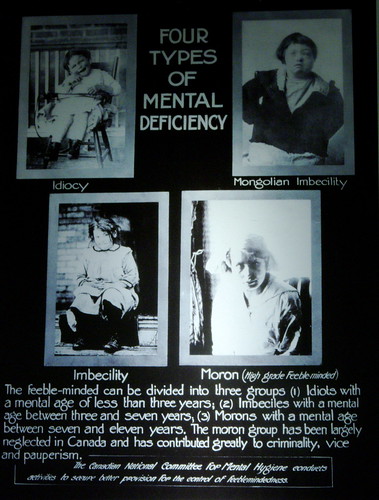
"Naming" is particularly poignant when you think about the fact that everyday speech still uses some of these words today in an altogether too pejorative way...

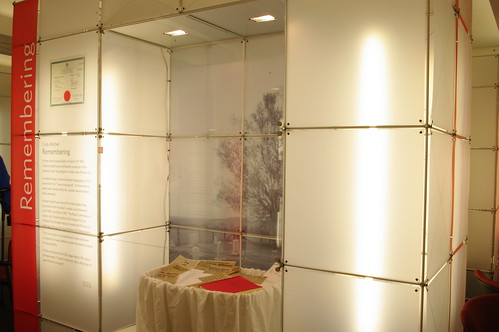
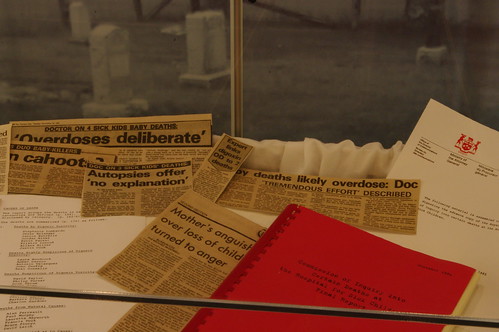
"Remembering" presented a painfully sad story about Kristen Anne Inwood, one of the 36 infants who died in the cardiac ward Toronto's Hospital for Sick Children in 1981.

"Cause of death was a deliberate overdose of the powerful heart drug digoxin. Kristen was 18 days old.

In medical slang, Kristen had been designated as “FLK”, an acronym for "funny looking kid". A chromosome exam was ordered while her cardiac abnormalities were assessed.

Kristen's death was one of 36 infant deaths that occurred on the hospital's cardiac ward between June 1980, and March 1981. The Royal Commission of Inquiry into Certain Deaths at the Hospital for Sick Children (the "Grange Inquiry") conducted 191 days of hearings probing the circumstances of these deaths.

The Commission concluded that Kristen had been murdered, but was unable to make any determination of responsibility. "

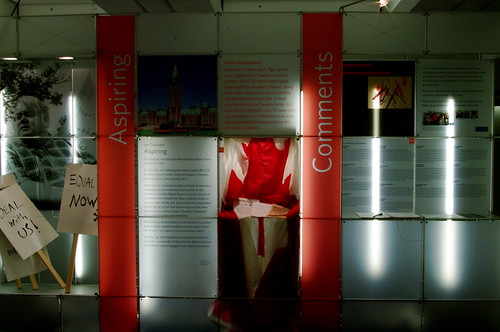
And then history starts to take a turn for the better as people with disabilities start to blaze trails, and communities of people with disabilities start to organize and rally.

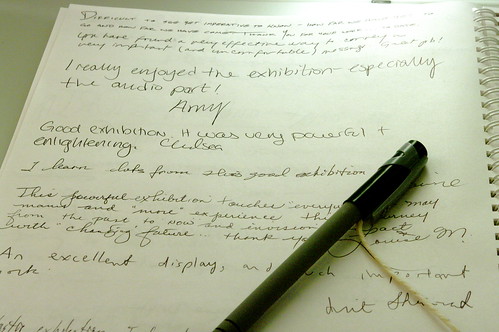
The comment book was bursting with praise. Rightly so.

And while there are still many battles to be fought, things have shifted in Canada over the years in terms of the recognition, acknowledgement and acceptance of people with disabilities. Although it's interesting to note that Catherine Frazee, a major part of the curatorial team had to travel from Toronto to Vancouver via AMTRAK in the United States. Why? Because Canada's Via Rail can't accommodate a person in a wheelchair.

So clearly, we've still got a long way to go......

Thursday, March 11, 2010

Cookies for Catherine: Gingersnap Raspberry Sandwiches


You know how I was recently talking bragging about the fact that I've had a lot of privileges of late? Well, one of them has been working with the amazing and brilliant Catherine Frazee. I met Catherine a bunch of years ago when I was working with another amazing and brilliant woman named Bonnie Sherr Klein on a beautiful film called Shameless: the ART of Disability.

In January, Catherine approached me about helping produce a recorded audio description to go with an installation produced by Ryerson University called: Out from Under: Disability, History and Things to Remember. Originally installed in the Royal Ontario Museum, Catherine was puttin' the show on the road and heading west.

And that's how I had the privilege of getting to work with Catherine again, on yet another amazing project. I plan to take more photos of Out from Under: Disability, History and Things to Remember this weekend and I'll do a post specifically about the installation which is now residing at UBC Robson Square. How I look forward to taking those photos and writing that post! But for tonight, I want to share some cookies with you.

Catherine lives in Ontario and Nova Scotia with her partner Patricia. And while we were corresponding, she started to tune into my humble little blog. And she MAY have mentioned on one or two occasions that she was lusting after some baked goods sugarlove style. So when I found out that Catherine and Pat were making the journey westward, I knew that I must spend a weekend in the kitchen baking for them! And here's one of the things I made for Catherine and Pat, with love.

Gingersnap Raspberry Sandwiches (from Martha Stewart)

Ingredients
1 stick of unsalted butter at room temperature
1/4 cup vegetable shortening
1 cup sugar
2 cups all purpose flour
2 tsps baking powder
1 tsp cinnamon
1 Tbsp ground ginger
1/4 cup pure maple syrup
1 large egg beaten
1 cup of raspberry jam (with seeds)

Preheat oven to 375 degrees and put the rack in the centre of the oven. Line a baking sheet with parchment paper. In the bowl of a stand mixer, cream the vegetable shortening, butter and cup of sugar until it's light and fluffy. (About 2 minutes). In a large bowl, sift together the flour, ground cinnamon, ground ginger, baking soda.

Add the maple syrup to the creamed butter and beat to combine. Beat in the egg. Reduce speed to low, and slowly add the sifted flour mixture a little bit at a time, until well blended.

Measure about 2 teaspoons of dough and roll into a ball. Roll the ball in sugar and gently press on the parchment paper until it's a round disc. Continue to do this, spacing the balls about 3 inches apart. Bake until golden about 11 minutes. Transfer to a rack and cool.

When the cookies are cool, spread a big dollop of jam over one side of a cookie and make a sandwich with a second cookie. Serve with a big glass of milk.

Monday, March 8, 2010

It's March 8. Happy International Women's Day.


Today is March 8.

If my father was still alive, today would have been his birthday. He died on father's day, 2008. On the day of his memorial service, the flags were flown at half mast at Memorial University in St. John's, Newfoundland. This event would have made him incredibly proud, because it signaled a huge achievement in his life. Against so many odds, he went for something that many would have said was impossible. He left a tiny outport in Newfoundland and Labrador to get an education. And later, he taught at the university that led him towards a brighter future. It was indeed a huge achievement.

Today is also International Women's Day. And last night, against all odds, something amazing happened. Kathryn Bigelow was the first woman in history to win the Oscar Award for outstanding direction of a film. In all 81 previous years of the Academy awards, no woman had ever won the coveted prize. In fact, only 4 women were even nominated.

Happy International Women's Day. It is indeed a day I won't forget....

Sunday, March 7, 2010

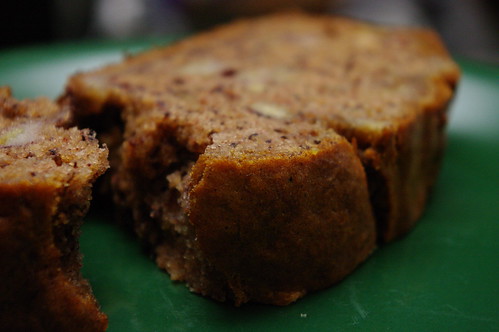
Banana Bread with Bourbon


Let's take a moment before the blog-curtain closes on those crazy winter games in spring-like conditions, and allow me to share with you a kick ass recipe for a banana bread that will leave you wanting more. Compliments of Smitten Kitchen, this recipe was dubbed

"Elise’s Friend Heidi’s Friend Mrs. Hockmeyer’s Banana Bread, As Jacked Up by Deb"

I like to call it

Banana Bread with Bourbon

3 to 4 ripe bananas, smashed
1/3 cup melted salted butter
1 scant cup light brown sugar
1 egg, beaten
1 teaspoon vanilla
1 tablespoon bourbon (optional)
1 teaspoon baking soda
Pinch of salt
1 teaspoon cinnamon
1/2 teaspoon nutmeg
Pinch of ground cloves
1 1/2 cup of flour

Preheat the oven to 350°F. Take yer bananas and, in a large bowl, smash 'em and mash 'em. Mix in the butter with a wooden spoon. Stir in the sugar, egg, vanilla and bourbon, then the spices. Sprinkle the baking soda and salt over the mixture and mix in. Add the flour last, mix. Pour mixture into a buttered 4×8 inch loaf pan. Bake for 50 minutes to one hour, or until a tester comes out clean. Cool on a rack. Remove from pan and slice to serve. A little dollop of butter makes this banana bread outta this world.

We had a slice after grilled cheese sammiches.... when we were watching the men's gold medal curling game. You know the one: Canada vs THE PANTS.

Friday, March 5, 2010

It was Newfoundland (and Labrador) Night.....


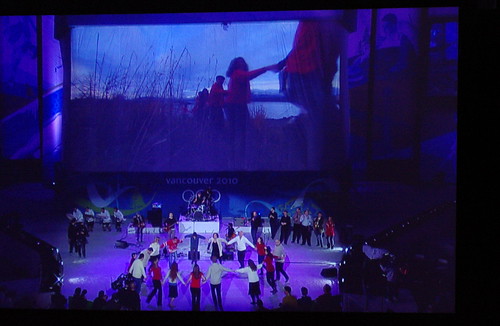
It was Newfoundland night last Thursday at the Olympic victory celebration, and what that meant is that I spent a good few hours getting all choked up. In fact, there were points at which I was downright sobbing in my seat when I saw my people live on stage and on video. Here's the thing about Newfoundland and Labrador: aside from being a drop dead gorgeous place (in a rugged, rocky sort of way), it is also home to some of the most brilliant and creative people you'd ever wanna meet. And as I watched the parade of Newfoundlanders sing and dance before me, I was filled with such pride and longing that I could've burst. But instead of bursting entirely, I just sprung a leak in my eyes...... It was yet another bittersweet function of these winter games.

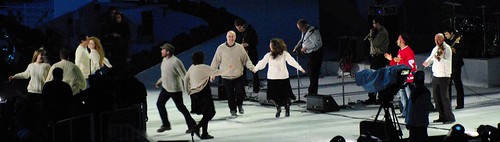
It all started with Shaun Majumder and fiddler Kelly Russell, who made jokes and music against a backdrop of images from Newfoundland. We were told about a posse of wild Newfoundlanders who were "Running the Goat" around the world and inviting people to join them. (I should tell you here that "Running the Goat" doesn't actually involve goats OR running. It's a dance. A beautiful, kooky dervish that lasts for about 10 minutes and is one heckuva a workout - what with all the moves like threading the needle, hand over hand, the whip and such)

And then, a pack of Newfoundlanders descended upon the stage and gave us a taste of "Running the Goat" while I sat there weeping in joy.

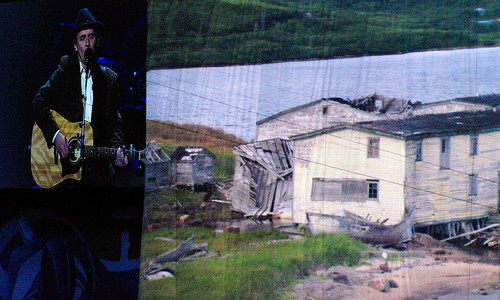
As if that wasn't enough to melt my heart into a big puddle, Ron Hynes came out on stage to sing "Sonny's Dream". That did me in.

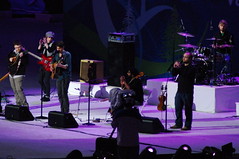
But wait - there's more! We were also joined by "Hey Rosetta", one of the hottest new bands in Newfoundland. I love them. They are completely creative and unique. Did I mention that I love them?

And then, the whole works came together onstage: Kelly, Shaun, Ron, Hey Rosetta, The Irish Descendents for a scuff. I'm pretty sure my hoots and hollers were heard on the other side of the mountains.

AND THEN, it was time for the main event - the headliner: Great Big Sea. My friend Bev came and found us in the audience to give us wristbands to get us onto the floor in front of the stage, where we joined the throngs to shake our booties. Talk about a room bustin' with joy:

We did pause long enough to snap this photo of Mister Man and Ms. Bev in front of the rings.

But the night ended too quickly, and before we knew it, the lights of "closing time" were bearing down upon us, and it was time to say goodnight Irene.

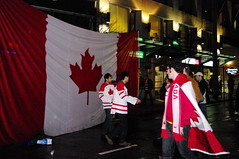
So we headed out on the streets where people were still celebrating. It was just that kind of week.

Wednesday, March 3, 2010

Burton Cummings Has Got it Going On


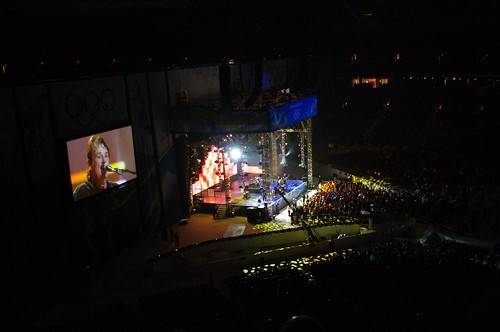
We went to a couple of the victory celebrations in which medals were handed out, and music was played. It was very cool to watch the athletes enjoy their well deserved moment in the sun. And to see some of our own Canadian peeps on the platform.

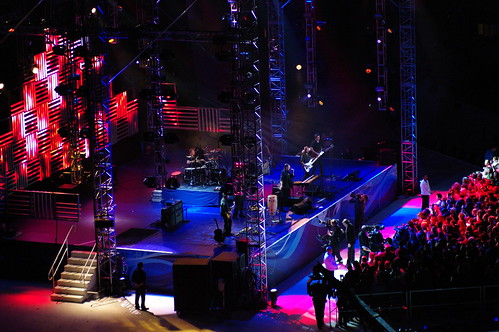
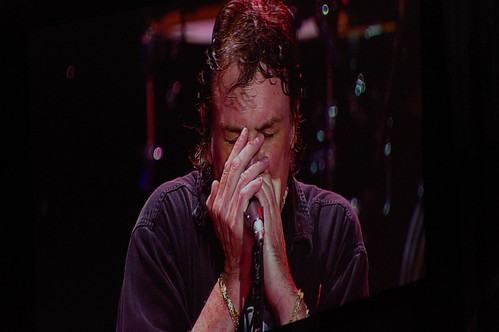
It was "Manitoba Night" on this particular evening, so all of the talent came from - you guessed it. The headliner? Burton Cummings. He. Was. Great. He emerged from this funkadoodle laser show.

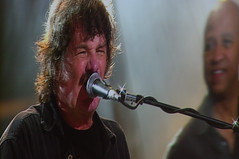
And there he was in all his glory.

Now, I am not a closet Cummings lover, but let me tell you that he churned out hit after hit after hit. Mister Man and I kept looking at each other going "Oh yeah... I forgot about that one": American Woman, Stand Tall, Those Eyes, Break it To them Gently, Fine State of Affairs, You Saved My Soul etc. etc. etc. Holy crow!!

In terms of performance, he wasn't at all like paunchy ol' Roger Daltry during the Super Bowl half time show - Burton Cummings still has his vocal chops. In fact, if we hadn't been sitting in row MM in the upper portion of the nosebleed section, why I might even have considered throwing my panties on the stage......

Tuesday, March 2, 2010

New Patriot Love (by Stephen Brunt from The Globe and Mail)


I am posting this today, because when I heard Stephen Brunt read it on CTV, I thought it was brilliant. And I cried. Because being at the epicentre of those winter games had such a powerful impact on so many people - it's inexplicable. This appeared in the Globe and Mail. And Stephen Brunt sums it up so beautifully, putting thoughts and feelings into words. These words.

By Stephen Brunt, The Globe and Mail Posted Friday, February 26, 2010 2:22 PM ET

"Perhaps we are really looking into a funhouse mirror, and the country reflected back to us, bold and loud and overtly patriotic, is a thing only of this time and place. Perhaps from here at ground zero, surrounded by the happy, face-painted Maple Leaf-bedecked mobs, perspective is skewed.

But it certainly seems as though something new and different has been happening in Canada these past two weeks - at the very least, a sudden loss of national self-consciousness.

A home-country Olympics has been the catalyst, and everyone knew it was coming, like Expo 67, or the previous two Games held in Canada, or the various international hockey triumphs that provided obvious opportunities to wave the flag.

Not this many flags, though, or this many choruses of O Canada, in its many permutations, from homemade and homely to hip hop. And most remarkable of all is that, for all of the preparation, and all of the packaged, premeditated tugging of heartstrings, this hasn't really proceeded according to script.

It was supposed to be a simple, inevitable march to glory. Enormous amounts of money (at least in Canadian terms) were invested in our athletes to guarantee that what had happened before - gold-medal-free Olympics in Montreal in 1976 and Calgary in 1988 - would not happen again. Success would not be a faint hope, it would be an expectation. We would own the podium, we would top the medal tables. Though it might seem antithetical to traditional notions of the national character, the overt confidence, the swagger of those newborn champions would set a tone for the country. As they witnessed triumph upon triumph, at each raising of the flag and singing of the anthem, as they witnessed other countries - especially the United States of America - left trembling in our wake, citizens would be suitably inspired, emboldened in their own lives, feel moved to hit new heights, feel kindly toward the government of the day (the propaganda possibilities of this exercise have been obvious at least since 1936), and not question for a minute the wisdom of the entire Olympic enterprise.

That was the narrative arc everyone anticipated, not just sports and Olympic administrators, but also those in control of the massive media consortium, which paid an unprecedented amount for the rights to the Games and was betting heavily on being able to wallow in Canadian success.

Instead, the show got off to an unequivocally awful start. Hours before the cauldron was lit, a luger was killed during a practice run, raising questions about the safety of the state-of-the-art track built specifically for these Olympics. A technical glitch marred the climactic moment of the Opening Ceremony, and freakishly warm weather threatened to melt the Cypress Mountain venue, forcing cancellations and eventually mass ticket refunds. The much-hyped Canadian hope for a home gold medal fell short on the opening day of competition, and the opportunistic overseas press corps focused in on every glitch, pronouncing the Vancouver-Whistler Olympics a failure and an embarrassment to the host country even before they had really begun.

It would have been no surprise in those circumstances for the country to curl up in the fetal position, to experience a great national cringe: We weren't good enough; in the big moment, we hadn't come through; we weren't up to the task; we should never have become involved (or spent the money) in the first place.

What happened instead were the streets of Vancouver filling with huge crowds, young, pan-ethnic, the very image of the place, decked out in national colours, patriotic gear the fashion statement of the moment, and that became the story. From across the country came reports of other gatherings, more modest naturally, and then the first television numbers, showing that unprecedented numbers of Canadians were tuning in. (And the changed medium itself was also part of the equation - the immersive effect of having everything from the Games available at all times on multiple platforms; watching hour after hour of the Olympics, following sports that otherwise aren't exactly top of mind, has always had a narcotic effect, but this time it was possible to inhabit virtual-Olympic-world 24 hours a day.)

Apparently, it wasn't all about flawless execution and it wasn't all about winning medals and it wasn't even all about sport. It was about providing an opportunity, a platform, an excuse, to let loose pent-up feelings of national pride, to express, without apology, with a spirit of joy, a national identity, hitting emotional notes beyond the usual touchstones of climate and geography, of politeness, tolerance, universal health care and hockey. It was fun (especially for those too young to have experienced the epiphany of the Canada-Soviet hockey series, 1972 - or even the Ben Johnson run of 1988) and it was liberating and it felt good, the power of collectively giving a damn.

By the time moguls skier Alexandre Bilodeau won that first Canadian gold medal in Canada, in so many ways the perfect poster boy for everything the Games are supposed to be about, it was becoming clear that the country outside the Olympic bubble was setting the tone, and not vice versa. During those distressing moments mid-Games when it began to dawn on everyone that the Own the Podium goals could not be reached, when several Canadian athletes seemed to buckle under the intense pressure, bureaucrats and reporters were busy counting up the medals and fretting over whether it was really a good idea to shoot so high, while outside the flag-waving proceeded unabated.

It wasn't until skeleton athlete Jon Montgomery's victory a week ago last Friday (following immediately on the heels of fellow slider Melissa Hollingsworth's teary disappointment, which was the Games' athletic nadir from a Canadian point of view), and his triumphant stroll through the streets of Whistler, grabbing a pitcher of beer along the way, that the Olympics caught up with the mood of the country. Then came Thursday, with four medals won and the one-sided hockey victory over Russia, and the stage was set for a weekend like no other.

Come Monday morning, come the weeks and months and years after that, who knows if there will even be a hint left behind of what has happened here beyond a short hangover? Whether all of those jerseys and flags and maple leaf hats will gather dust in some closet, like artifacts of a graduation, of a wedding, other signpost moments that are over, and gone.

Public displays of patriotism would seem unlikely to become the norm. But given the opportunity, given the excuse, who would be surprised now if this happens again? The want seems to be there, the need seems to be there, and maybe it has been there percolating all along - the desire to join together and celebrate ourselves, to be a tribe."

Thank you Stephen Brunt. You have put into words this amazing feeling that's been resonating on the streets of Vancouver for the past 2 weeks.